The Lessons of History by Will Durant
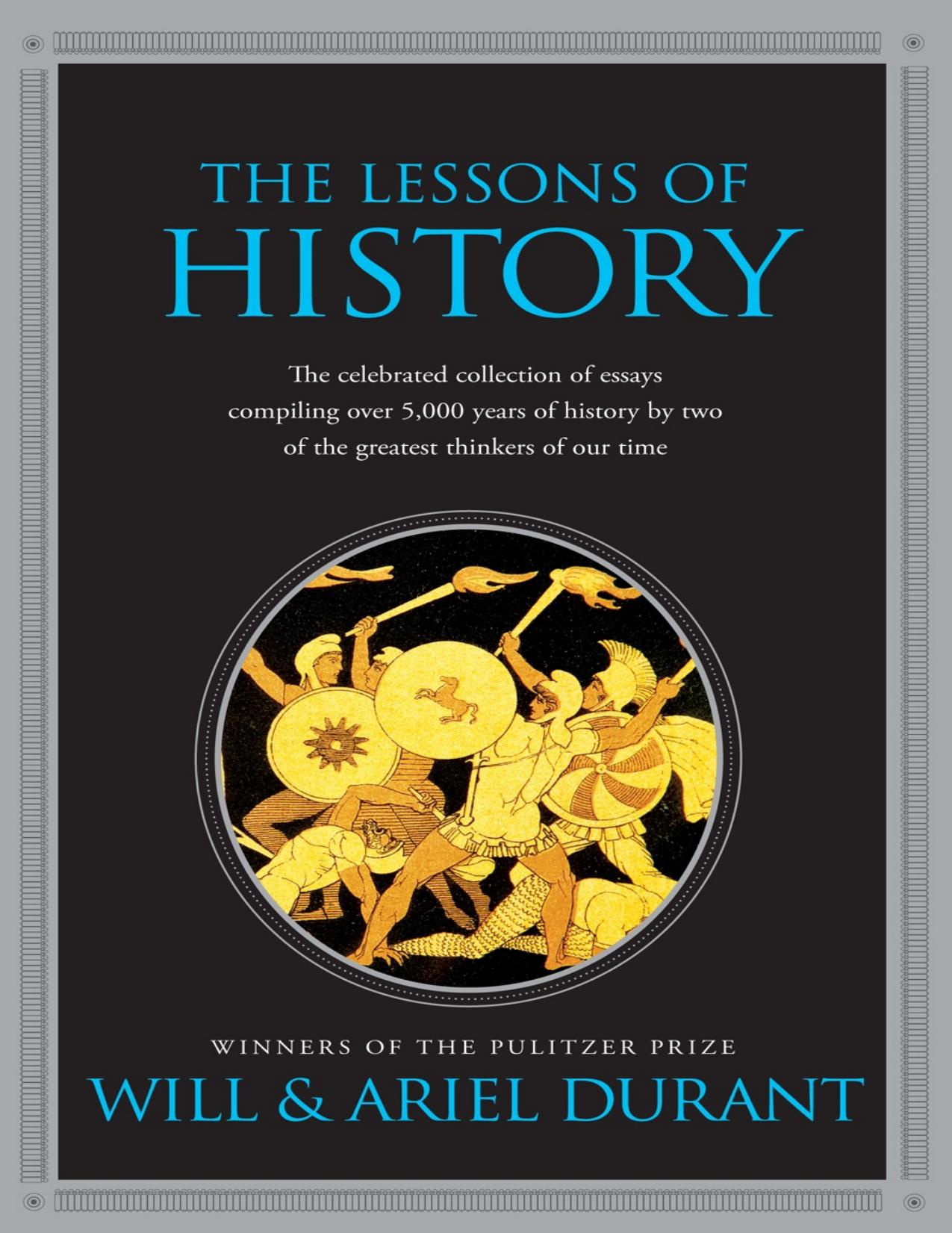
Author:Will Durant
Language: eng
Format: epub, mobi, pdf
Publisher: Simon & Schuster
Published: 1968-08-16T04:00:00+00:00
X. Government and History
Alexander Pope thought that only a fool would dispute over forms of government. History has a good word to say for all of them, and for government in general. Since men love freedom, and the freedom of individuals in society requires some regulation of conduct, the first condition of freedom is its limitation; make it absolute and it dies in chaos. So the prime task of government is to establish order; organized central force is the sole alternative to incalculable and disruptive force in private hands. Power naturally converges to a center, for it is ineffective when divided, diluted, and spread, as in Poland under the liberum veto; hence, the centralization of power in the monarchy by Richelieu or Bismarck, over the protest of feudal barons, has been praised by historians. A similar process has centered power in the federal government in the United States; it was of no use to talk of “states’ rights” when the economy was ignoring state boundaries and could be regulated only by some central authority. Today international government is developing as industry, commerce, and finance override frontiers and take international forms.
Monarchy seems to be the most natural kind of government, since it applies to the group the authority of the father in a family or of the chieftain in a warrior band. If we were to judge forms of government from their prevalence and duration in history we should have to give the palm to monarchy; democracies, by contrast, have been hectic interludes.
After the breakdown of Roman democracy in the class wars of the Gracchi, Marius, and Caesar, Augustus organized, under what in effect was monarchical rule, the greatest achievement in the history of statesmanship—that Pax Romana which maintained peace from 30 B.C. to A.D. 180 throughout an empire ranging from the Atlantic to the Euphrates and from Scotland to the Black Sea. After him monarchy disgraced itself under Caligula, Nero, and Domitian; but after them came Nerva, Trajan, Hadrian, Antoninus Pius, and Marcus Aurelius—“the finest succession of good and great sovereigns,” Renan called them, “that the world has ever had.”53 “If,” said Gibbon, “a man were called upon to fix the period during which the condition of the human race was most happy and prosperous, he would without hesitation name that which elapsed from the accession of Nerva to the death of Marcus Aurelius. Their united reigns are possibly the only period of history in which the happiness of a great people was the sole object of government.”54 In that brilliant age, when Rome’s subjects complimented themselves on being under her rule, monarchy was adoptive: the emperor transmitted his authority not to his offspring but to the ablest man he could find; he adopted this man as his son, trained him in the functions of government, and gradually surrendered to him the reins of power. The system worked well, partly because neither Trajan nor Hadrian had a son, and the sons of Antoninus Pius died in childhood. Marcus Aurelius had
Download
The Lessons of History by Will Durant.epub
The Lessons of History by Will Durant.mobi
The Lessons of History by Will Durant.pdf
This site does not store any files on its server. We only index and link to content provided by other sites. Please contact the content providers to delete copyright contents if any and email us, we'll remove relevant links or contents immediately.
| Africa | Americas |
| Arctic & Antarctica | Asia |
| Australia & Oceania | Europe |
| Middle East | Russia |
| United States | World |
| Ancient Civilizations | Military |
| Historical Study & Educational Resources |
Cecilia; Or, Memoirs of an Heiress — Volume 1 by Fanny Burney(32563)
Cecilia; Or, Memoirs of an Heiress — Volume 2 by Fanny Burney(31962)
Cecilia; Or, Memoirs of an Heiress — Volume 3 by Fanny Burney(31945)
The Secret History by Donna Tartt(19105)
Sapiens: A Brief History of Humankind by Yuval Noah Harari(14394)
Leonardo da Vinci by Walter Isaacson(13342)
The Radium Girls by Kate Moore(12036)
Sapiens by Yuval Noah Harari(5375)
How Democracies Die by Steven Levitsky & Daniel Ziblatt(5225)
The Wind in My Hair by Masih Alinejad(5104)
Homo Deus: A Brief History of Tomorrow by Yuval Noah Harari(4923)
Endurance: Shackleton's Incredible Voyage by Alfred Lansing(4790)
Man's Search for Meaning by Viktor Frankl(4612)
The Silk Roads by Peter Frankopan(4538)
Millionaire: The Philanderer, Gambler, and Duelist Who Invented Modern Finance by Janet Gleeson(4483)
The Rape of Nanking by Iris Chang(4224)
Joan of Arc by Mary Gordon(4119)
The Motorcycle Diaries by Ernesto Che Guevara(4106)
Stalin by Stephen Kotkin(3973)
